
Some months feel good. The diary was full and there was money in the bank at the end of it. Other months feel tight, even though you worked just as hard. What most owners can’t tell you is why. Was the good month good because the business is set up to make money, or did a few big jobs land at the right time?
Your break-even point answers that question. It’s the level of work your business has to do each month just to cover its costs. Everything above it is profit. Everything below it is a loss, however busy you were.
Why revenue is the wrong way to measure it
Break-even is usually taught as a dollar figure, such as needing $40,000 of revenue a month. That’s accurate, but you can’t see $40,000 in your diary. You can see jobs booked, clients seen, tables filled and days billed.
So work out break-even in the unit your business actually runs on. For a trades business that’s jobs. For a clinic it’s appointments. For a consultant it’s billable days. Once break-even is in those terms, you can look at next week’s schedule and know straight away whether you’re ahead or behind.
Start by splitting your costs
Fixed costs are the ones you pay whether you do one job this month or fifty. Rent, insurance, software, vehicle leases, and the wages of anyone paid regardless of workload. Include a market salary for yourself here too. If you’re not paying yourself what it would cost to replace you, the business looks more profitable than it is.
Variable costs go up and down with the work you do. Materials, subcontractors, card fees, and any labour directly tied to delivering the job. If your team’s hours rise and fall with the workload, treat that labour as variable. If they’re paid the same whatever happens, treat it as fixed. This split is where most break-even calculations go wrong, so be honest about it.
The calculation
There are three steps. First, take your average price for a unit of work and subtract the variable cost of delivering it. What’s left is what each job contributes towards your fixed costs. Second, divide your monthly fixed costs by that contribution to get your monthly break-even. Third, break that down into a weekly target you can track.
Here’s how that looks for a trades business, using made-up figures. Its monthly fixed costs are $18,000, including the owner’s salary. The average job is $1,200, and the materials and direct labour on that job cost $700.
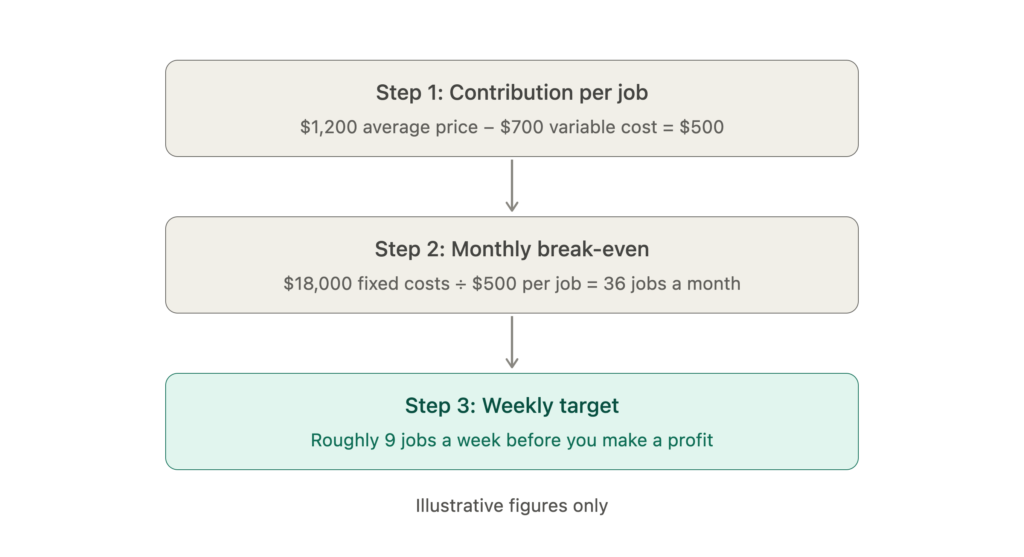
Each job contributes $500, so the business needs 36 jobs a month, or roughly nine a week, before it makes a dollar of profit. Nine jobs a week is a number you can plan around.
Why a blended margin can hide the answer
Most businesses sell a mix: a quick callout and a full install, a standard appointment and a longer treatment. It’s tempting to use one average margin across everything, but that average can mislead you.
Say our trades business does two kinds of work. Small callouts contribute $300 each and larger installs contribute $900 each. If the month fills with callouts, the business can complete its 36 jobs, feel flat out, and still fall short. Thirty-six callouts contribute $10,800 against $18,000 of fixed costs.
Work out the contribution for each main type of work, not just the average. It often shows that some services carry the business while others barely pay their way, and that changes what you market and prioritise.
Use it every week, not once a year
Put your weekly target where you’ll see it. At the end of each week, compare what you delivered against that target. If you’re behind by Wednesday, you still have time to follow up quotes, contact past customers or fill gaps in the schedule. If you only find out at year end, all you can do is explain what went wrong.
Revisit the calculation whenever something significant changes, such as a rent increase, a new staff member, a price rise or higher supplier costs. Check it at least once a quarter even when nothing obvious has changed.
Want to go further with your numbers?
Once you know your break-even point, a good month stops being a matter of luck. You can see how far above the line you are, which work got you there, and what to aim for next. It’s one of the most useful things you can know about your business, and it’s often the first question that leads to the next one: where else is profit being left on the table?
That’s where our free workshops come in – Find $10K of Extra Revenue and Crack the Code. Both are free and designed for owner-operators who want practical steps they can apply to their own business. If this blog article has you thinking about your numbers, a workshop is an easy next step.


